
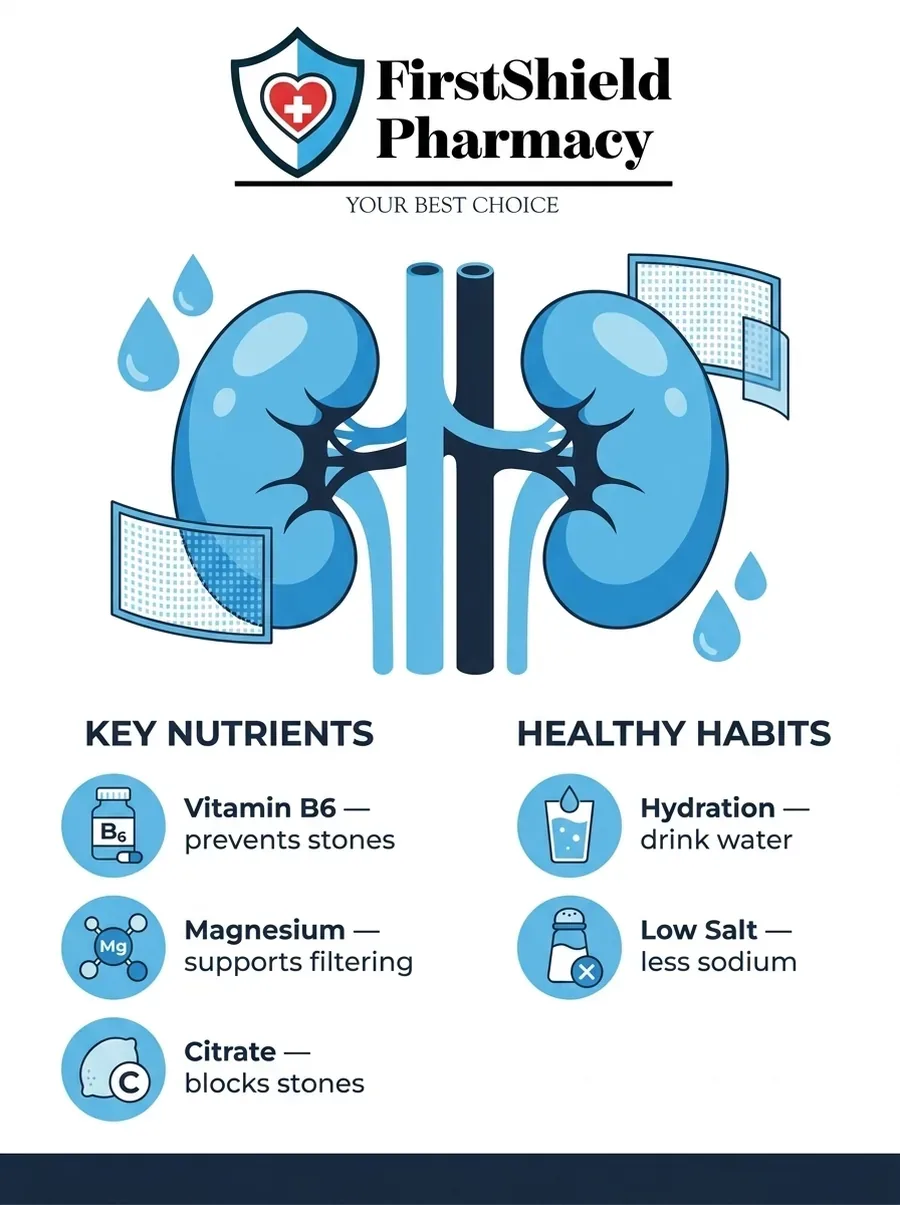
Your kidneys filter your blood all day. Water and a few careful choices help keep them healthy.
Nutrients that support your kidneys
Water
Flushes the kidneys and bladder and keeps urine dilute, which helps prevent stones and infections.
- How much you need: About 2–3 litres a day — unless a doctor has limited fluids (heart or kidney failure).
- Best food sources: Water, buttermilk, tender coconut water, lemon water.
Vitamin B6
Helps the body use protein and make red blood cells; may help prevent some kidney stones (oxalate type).
- How much you need: About 2 mg a day from food.
- Best food sources: Bananas, pulses, potatoes, nuts, meat.
Be careful:
- More than 100 mg a day for months can damage nerves.
Magnesium
Needed by muscles and nerves, for a steady heart rhythm, and for bone.
- How much you need: Men 440 mg, women 370 mg a day (ICMR-NIN 2020).
- Best food sources: Nuts, seeds, whole grains, pulses, green leafy vegetables.
Be careful:
- Kidney disease: not without a doctor.
- Can loosen stools.
Citrate
Citrate in urine helps stop stones forming.
- How much you need: From food; potassium citrate tablets are prescription only.
- Best food sources: Lemon juice in water, oranges, tender coconut water.
Be careful:
- Kidney stones need a doctor’s plan — potassium citrate is a prescription medicine.
Everyday habits that help
- Drink water
- Low salt
When to see a doctor: With kidney disease many supplements (magnesium, potassium, high protein) can harm — always ask the doctor.
Before you take any supplement
- Supplements fill a gap in the diet; they do not treat disease. Anyone with a diagnosed condition (diabetes, kidney, liver or heart disease) or on regular medicines should ask their doctor first.
- Doses here are for ADULTS. Children’s and pregnancy supplements are chosen by the doctor.
- Only products made entirely of nutrients are suggested (vitamins, minerals, probiotics, amino acids, plant extracts) — anything that also contains a drug is left out.
- Daily amounts are the ICMR-NIN 2020 recommended dietary allowances where one exists; more is not better.
- Products are listed focused-first (1–3 ingredients), then multivitamins, each by how often our shops sold it — a multivitamin may carry only a small amount of a given nutrient.
Not sure what suits you? Ask our pharmacist at any FirstShield store, or message us on WhatsApp.